
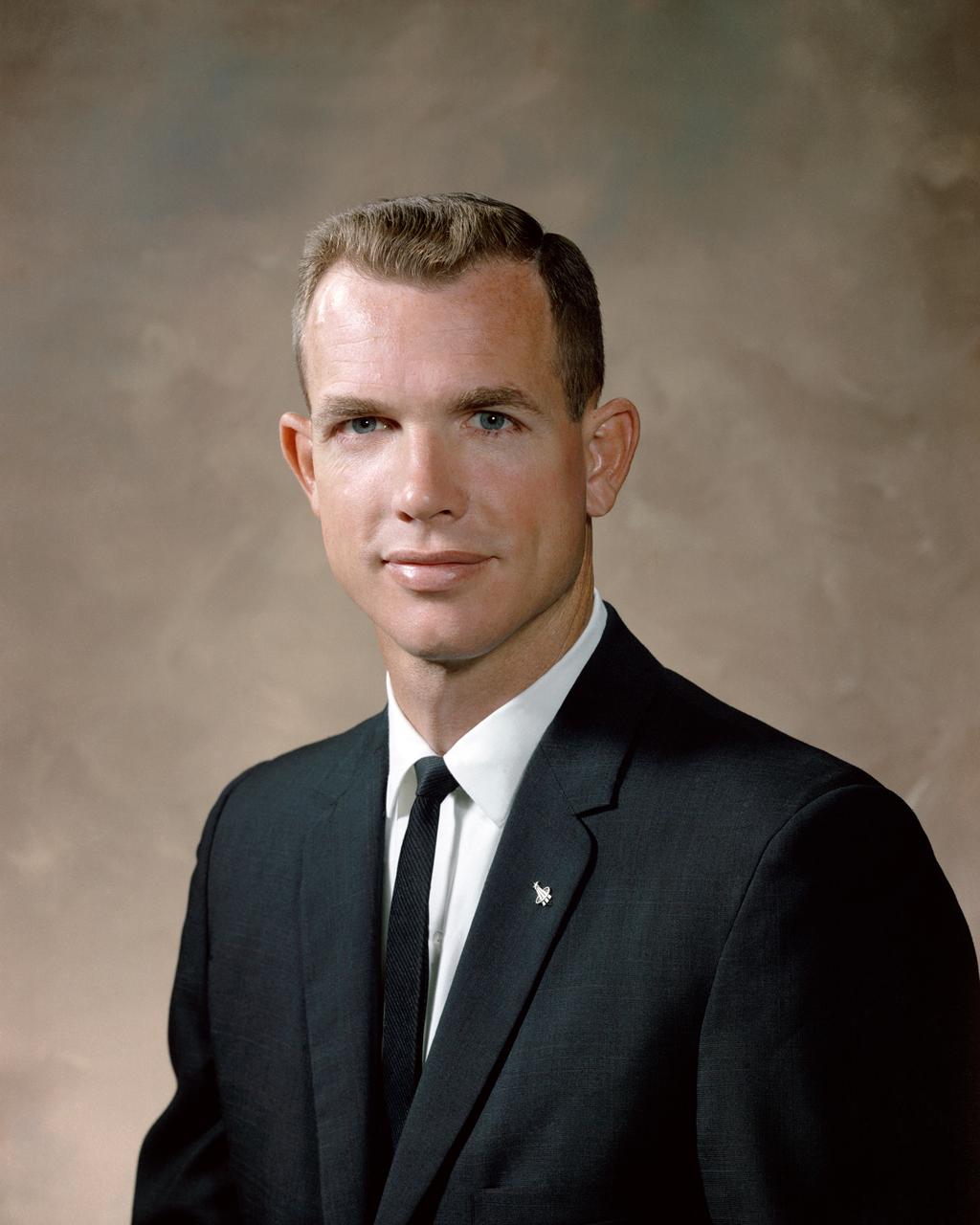
On September 20, 1965, David Scott was assigned as the pilot for the Gemini 8 spaceflight. Scott would also perform a spacewalk during this flight. Scott’s assignment was surprising, as it had been expected that the backup pilot for Gemini 5, Elliot See, would be nominated, but apparently there were concerns that See would not be capable of performing a spacewalk. Thus, Scott went on a flight without having previously been part of a backup crew. He was the first of the third group of astronauts to be nominated for a flight.
Together with commander Neil Armstrong, also a spaceflight novice, Scott launched on March 16, 1966, for his first spaceflight. As planned, Armstrong and Scott performed a rendezvous in Earth orbit with a previously launched Agena stage. They then achieved the first docking in orbit in the history of spaceflight.
However, a malfunctioning thruster caused the Gemini spacecraft to tumble violently, a tumbling that intensified when the spacecraft separated from the Agena stage. Armstrong and Scott were in mortal danger but managed to regain control. Because this maneuver consumed too much fuel, the spaceflight had to be aborted and an emergency landing initiated. Scott’s spacewalk was canceled.
Together with Commander James McDivitt and lunar module pilot Rusty Schweickart, Scott launched on Apollo 9 on March 3, 1969, during which the flight maneuvers for a lunar landing were performed for the first time. On March 6, Scott finally performed a spacewalk, although he was still connected to the spacecraft’s life support systems. He stood in the command module hatch for an hour and photographed Schweickart’s exit.
On the fifth day of the mission, the lunar module, with Schweickart and McDivitt aboard, undocked from the command module, which now contained only Scott. After testing the lunar module, the two spacecraft docked again, and Schweickart and McDivitt rejoined Scott in the command module. Thus, Scott was also involved in the first docking maneuver of two manned spacecraft in space, in which the crew (unlike with Soyuz 4 and Soyuz 5) could transfer directly without having to exit the spacecraft.
Shortly after the Apollo 9 landing on April 10, 1969, Scott was assigned as commander of the backup crew for Apollo 12. Had Pete Conrad been unable to participate, Scott would have become the third person to walk on the Moon. However, Scott was not deployed and served as a CAPCOM (Capsule Communicator) during the flight in November 1969.
As planned, the Apollo 12 backup crew was promoted to the primary crew for Apollo 15. Scott thus became the first astronaut from the third selection group to assume command of a spaceflight.
Scott launched on this third mission on July 26, 1971, along with James Irwin and Alfred Worden. On July 31, Scott became the seventh person to walk on the Moon. This was the first lunar mission in which scientific research played a major role. Scott and Irwin also had access to the Lunar Roving Vehicle (LRV) for the first time, enabling them to travel greater distances than ever before.
Just before Scott and Irwin re-entered the lunar module Falcon, Scott demonstrated with a falcon feather and a hammer that the falling speed of an object in a vacuum is independent of its mass.
Shortly after landing, the entire Apollo 15 crew had been assigned as backups for the final lunar mission, Apollo 17. However, during the following year, their involvement in the Apollo 15 stamp scandal came to light. Scott, Worden, and Irwin had taken envelopes on their mission that had not been explicitly authorized and which were later sold by a German dealer. Disciplinary proceedings were initiated against Scott, Worden, and Irwin, and on May 23, 1972, they were removed from the backup crew for Apollo 17. It was clear that there would be no further spaceflight for Scott and his crew, but they were neither convicted nor expelled from the astronaut corps or even NASA.
Unlike Irwin, Scott initially remained with NASA, working at the NASA Flight Research Center, later the Dryden Flight Research Center, located at Edwards Air Force Base. He was involved in the preparations for the Apollo-Soyuz Test Project and traveled to the Soviet Union several times. When he was offered the directorship of the Dryden Research Center in April 1975, he left the Air Force and became a NASA employee.
In October 1977, Scott left NASA and founded his own company, Scott Science and Technology. Subsequently, he worked as a technical consultant in the film and television industry on several occasions: in 1994/1995 for the feature film Apollo 13, in 1997 for the series From the Earth to the Moon, and in 2005 for the film Magnificent Desolation.
David Scott has two children from his first marriage. He lives with his second wife, Margaret Black-Scott, in Los Angeles, California.