
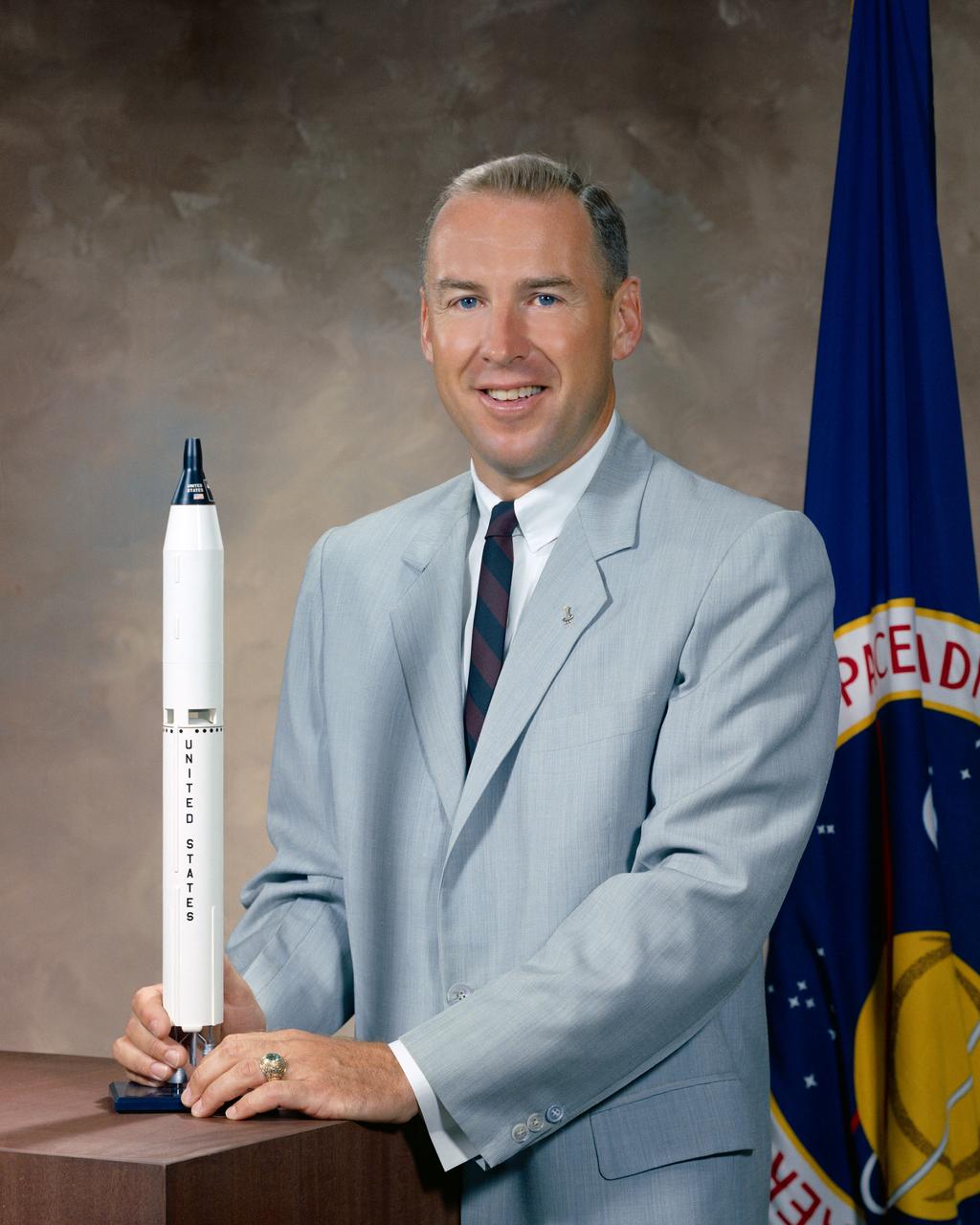
He received his first spaceflight assignment in June 1965, when he was named as a backup pilot for Gemini 4. Had Edward White been unable to fly, Lovell would have become the first American to leave his spacecraft while in Earth orbit to perform a spacewalk.
On July 1, 1965, he was named as a pilot for Gemini 7. On December 4, 1965, he and Frank Borman launched on this long-duration mission. By spending 14 days in space, the pair set a new record—one that was not broken until June 1970, when the crew of the Soviet spacecraft Soyuz 9 reached 17 days in orbit.
Following the fatal plane crash that claimed the lives of astronauts Elliot See and Charles Bassett in March 1966, the crew assignments for the Gemini missions were reorganized; Lovell was subsequently named backup commander for Gemini 9. During the Gemini 8 mission in March and the Gemini 9 mission in June 1966, Lovell served as the capsule communicator (CAPCOM) at Mission Control in Houston.
Shortly after the landing of Gemini 9 on June 17, 1966, Lovell was selected for his second spaceflight—his first as mission commander. He and Buzz Aldrin were assigned to carry out the final Gemini mission, Gemini 12, which took place in November 1966.
Next, Lovell was assigned to the crew of Apollo 8. The Apollo 8 mission, which ran from December 21 to December 27, 1968, marked the first crewed launch of the Saturn V rocket and the first human voyage to the Moon.
For the Apollo 14 mission, Lovell was initially slated to serve as commander, while Alan Shepard, who had been absent for an extended period due to health reasons, was intended to lead Apollo 13. However, NASA management decided to grant Shepard more time; consequently, Shepard was assigned to Apollo 14, and on August 6, 1969, Lovell was named commander of Apollo 13. He was thus set to become the fifth person to set foot on the Moon. With the Apollo 13 mission, Lovell also became the first person to complete four spaceflights.
The mission launched on April 11, 1970. An explosion on board the spacecraft, however, forced the crew to merely orbit the Moon rather than land on it. Lovell and his crewmates (Fred Haise and Jack Swigert) narrowly escaped death. As a result, Lovell never set foot on the Moon. He remains the only person to have flown to the Moon twice without ever landing on its surface.
For a long time, Lovell held the duration record for crewed spaceflights at 715 hours, a record that was not broken until 1973 by the crew of Skylab 2. Another record, which he set together with Haise and Swigert, was the greatest distance from Earth ever reached by a human: 401,056 km. This record was broken in 2026 by the Artemis II mission.
Lovell left NASA and the Navy on March 1, 1973, and transitioned to the private sector.
Jim Lovell passed away on August 7, 2025, at the age of 97, in Lake Forest, Illinois.