
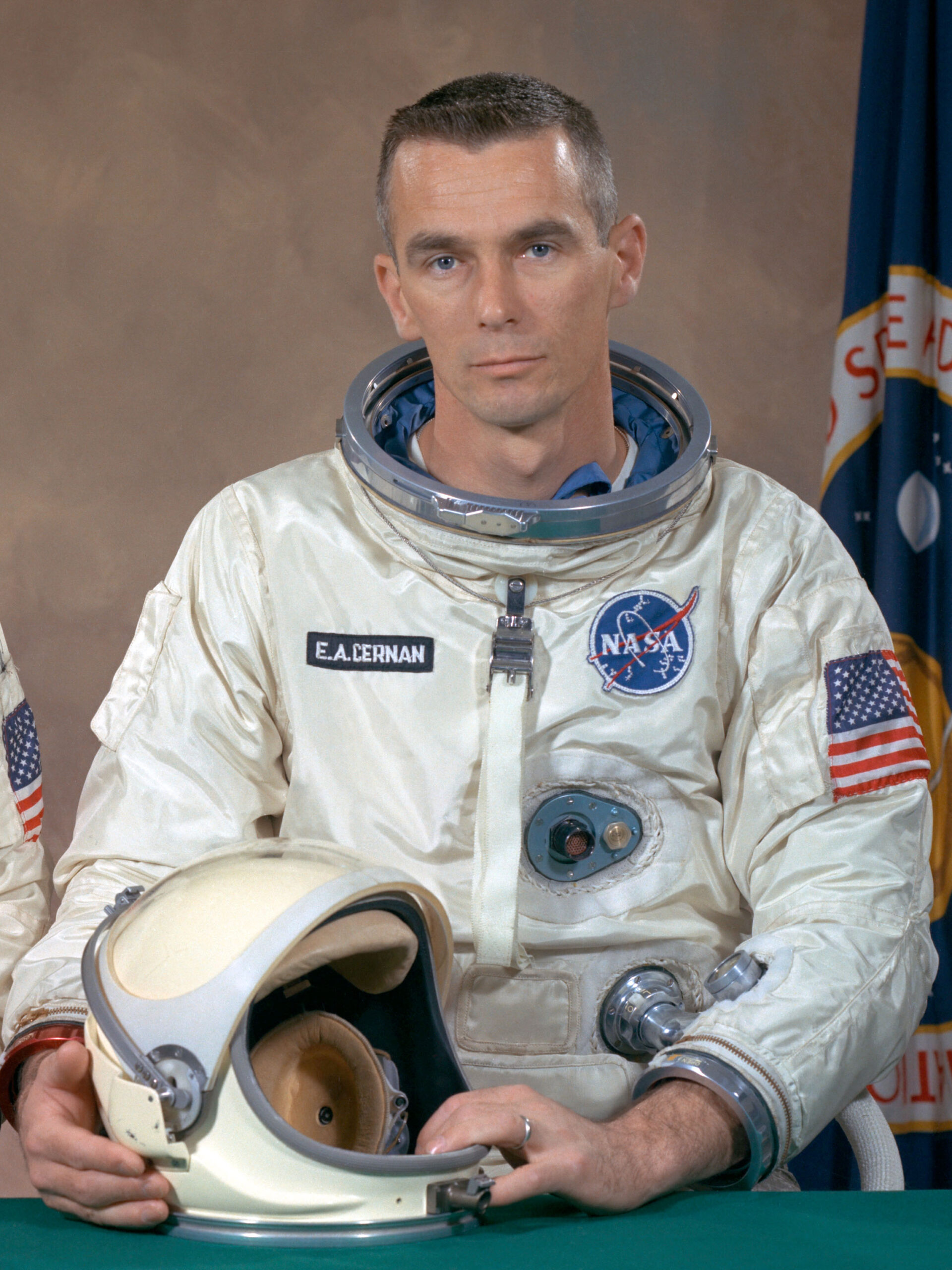
During the first Gemini missions (Gemini 1 in April 1964 to Gemini 5 in August 1965), Cernan worked in mission control, where he was responsible for monitoring the fuel tanks during launch.
On November 8, 1965, Cernan was nominated as a backup pilot for the Gemini 9 mission. This also gave him a strong chance of being assigned to the final flight, Gemini 12.
During the Gemini 7 and Gemini 6 dual mission in December 1965, Cernan served as a CAPCOM (Capsule Communicator).
The primary crew of Gemini 9 consisted of Commander Elliot See and Pilot Charles Bassett, who was to perform an EVA (Extravehicular Activity). The alternate commander was Tom Stafford.
As part of their training program, the primary and alternate crews of Gemini 9 flew to St. Louis on February 28, 1966, in two two-seat jets, where they were to train on the Gemini simulator at the McDonnell Aircraft Corporation. Due to poor visibility, See and Bassett’s aircraft crashed, killing both of them. Later that same day, Stafford and Cernan were confirmed as the new primary crew, thus giving Cernan the task of performing the second American EVA, following Edward White’s Gemini 4 mission.
The launch of Gemini 9 was initially scheduled for May 17, 1966, but was canceled at short notice after Stafford and Cernan were already aboard the spacecraft. The launch of the target satellite, which had taken place shortly before, had failed, leaving no docking partner available.
The launch was to be repeated on June 1 with the simpler target satellite, ATDA. This time, ATDA was successfully placed into orbit, but the launch had to be aborted just before Gemini 9 was to ignite because necessary data could not be transmitted from the ground station to the spacecraft.
On June 3, the third launch attempt finally succeeded, and Cernan began his first spaceflight. He was the second astronaut from the third selection group to fly in space.
However, once in Earth orbit, it became apparent that the target satellite’s fairing had only partially detached, making the planned docking impossible. NASA considered having Cernan exit the spacecraft and detach the fairing manually, but this was deemed too dangerous. The only previous EVA had consisted solely of exiting and re-entering the spacecraft, and there was no prior experience with movement and work in weightlessness.
The planned EVA was still ambitious enough. Cernan was scheduled to exit the Gemini spacecraft through the hatch on June 5, 1966, clamber along the rear of the spacecraft, and strap on an Advanced Maneuvering Unit (AMU) developed by the US Air Force. However, this proved considerably more difficult than anticipated. There were too few handholds, so Cernan progressed much more slowly than planned. By the time he finally reached the rear of the spacecraft, he was far behind schedule and exhausted. The test of the AMU had to be canceled. The return to the hatch proved even more difficult and dangerous. The cooling system of his spacesuit couldn’t compensate for the heat radiating from his body, and Cernan’s visor fogged up, leaving him with no visibility. The lack of gravity also made orientation nearly impossible. With his last ounce of strength, Cernan managed to return to the spacecraft. Climbing back through the hatch into the spacecraft’s interior became an additional feat of strength, because, as with Alexei Leonov and Ed White, his spacesuit had inflated, making re-entry almost impossible. Nevertheless, he had set a new record for the duration of a spacewalk, lasting over two hours.
Shortly after the flight ended, on June 17, 1966, Cernan was nominated as a reserve pilot for the next available Gemini 12 flight, but he was not used. Afterwards, Cernan was assigned to the Apollo project.
On May 18, 1969, Cernan, along with Tom Stafford and John Young, launched on his second spaceflight. After Apollo 8, this was only the second mission to the Moon. On the fourth day of the mission, the Apollo spacecraft entered lunar orbit. Cernan and Stafford transferred to the lunar module Snoopy and undocked from the command module Charlie Brown. During this part of the flight, a mishap occurred when Stafford and Cernan, in their enthusiasm, accidentally flipped a switch twice. This caused the lunar module to wobble violently. However, Stafford was able to prevent a more serious incident by switching to manual control. On the return flight to Earth, the lunar module reached a record speed of 39,897 km/h (20,000 mph). Cernan, Stafford, and Young thus hold the record for the fastest time relative to Earth.
On August 13, 1971, shortly after the Apollo 15 flight, NASA announced that Cernan, Evans, and Schmitt would form the crew of the last moon flight; the backup crew would be the Apollo 16 crew, as it would not have been worthwhile to train a completely new crew for the last moon flight.
The Apollo 17 mission launched on December 7, 1972. It was the first crewed night launch in American spaceflight. Cernan and Schmitt landed the lunar module Challenger near the Littrow Crater in Mare Serenitatis. Cernan became the eleventh person to walk on the Moon. The mission was a resounding scientific and technical success, resulting in the longest EVA time on the Moon, the largest amount of lunar rock collected, and the greatest distance traveled by the lunar rover (35 km). Cernan and Harrison Schmitt also set the unofficial lunar landing speed record of 18 km/h.
On December 14, 1972, at 05:40 UTC, Cernan became the last human to leave the lunar surface, which has remained untouched by humans ever since.
Eugene “Gene” Cernan died on January 16, 2017, at the age of 82 in Houston, Texas, following a long-standing health crisis.