
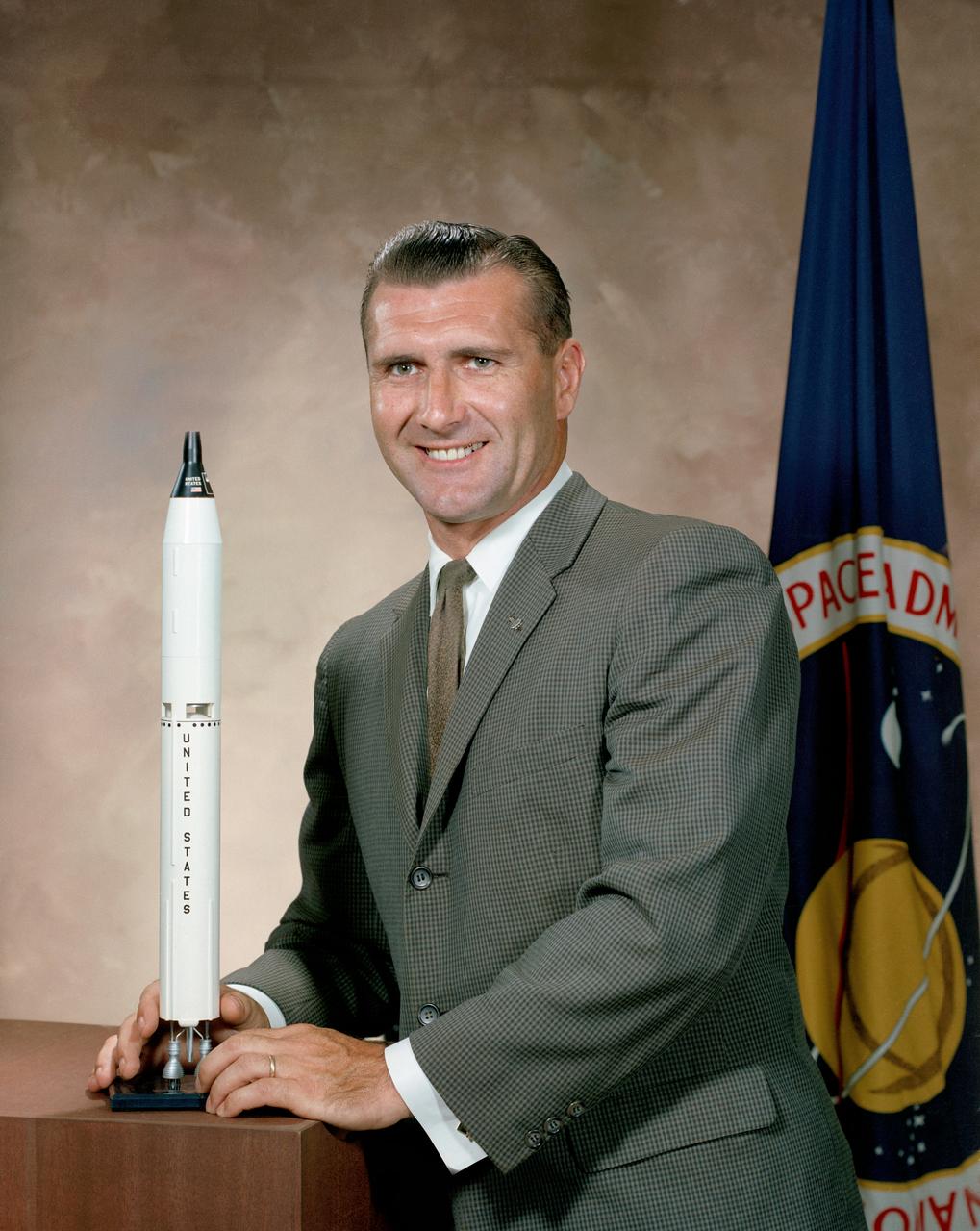
After six months of theoretical training, in July 1964 each of the 14 new astronauts was assigned a specific area of responsibility. Gordon was responsible for the design and layout of the Apollo spacecraft’s controls. He worked closely with the manufacturers’ engineers on this.
Since September 1965, Gordon had been part of the backup crew for Gemini 8 and, as expected, was called up to the flight crew of Gemini 11 six months later. This three-day mission took place in September 1966. The main task was approaching and docking with the Agena target satellite, which was accomplished to the satisfaction of all involved, as were the two spacewalks (EVAs) that Gordon performed on two consecutive days.
One year after his maiden flight, Gordon was appointed as the pilot of the command module for the Apollo 8 backup crew, and nine months later he was placed in that role for Apollo 9.
From March 1969, Gordon served as the command module pilot for Apollo 12. As with his first flight on Gemini 11, the commander was Pete Conrad. Apollo 12 was the second manned lunar landing and took place in November 1969. After the lunar module “Intrepid” landed, Conrad became the third person to walk on the Moon, followed by lunar module pilot Alan Bean as the fourth. Gordon remained aboard the command module “Yankee Clipper” throughout the entire mission.
On March 26, 1970, the crew of Apollo 15 was announced, with Gordon as backup commander. Since the backup crew typically became the primary crew three flights later, Richard Gordon, Vance D. Brand, and Harrison Schmitt had reasonable hopes of being selected for Apollo 18. On September 2, 1970, this planned flight, along with Apollo 19 and 20, was canceled by NASA. In January 1972, Gordon left NASA.
Richard Gordon died on November 6, 2017, in San Marcos, California, at the age of 88. He was buried in Arlington National Cemetery.