
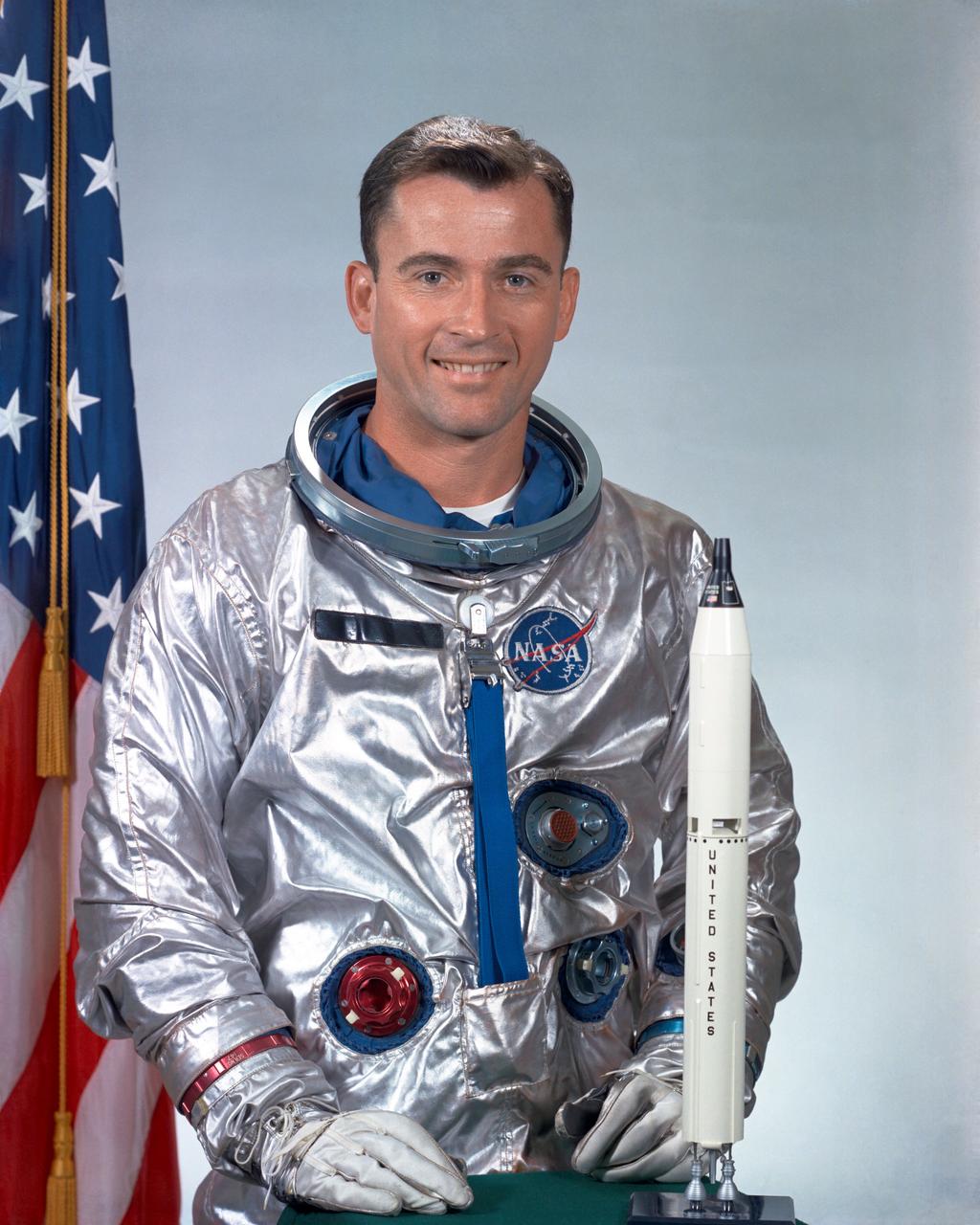
The Gemini spacecraft required active piloting and the ability to dock with other spacecraft; furthermore, extravehicular activities (spacewalks) were planned. The astronaut candidates also had to familiarize themselves with a much wider range of launch vehicles, as the subsequent Apollo program was already in the planning stages. Consequently, they visited various manufacturing and assembly facilities, as well as the launch pads for the Titan, Atlas, Agena, and Saturn rockets. In addition, the curriculum included scientific training, as research tasks were to be carried out during the spaceflights.
In January 1963, he was assigned the specialty area of astronaut equipment for spacecraft, a role that encompassed both personal gear and emergency equipment for use in the event of an emergency landing or splashdown. During the Mercury program, this area had been the responsibility of Gordon Cooper.
On April 13, 1964, Young was named pilot for the first crewed flight of the Gemini spacecraft, replacing Tom Stafford, whose rapport with the mission commander, Gus Grissom, was less than ideal. This made Young the first astronaut from the second group to be selected for a space mission.
On March 23, 1965, serving under the command of Mercury veteran Gus Grissom, who, on this mission, became the first person to fly in space for a second time, Young took part in Gemini 3, the first U.S. two-man spaceflight and the maiden crewed voyage of the Gemini spacecraft.
On January 25, 1966, Young was named commander of Gemini 10, with Mike Collins, who would later serve as the command module pilot for the Apollo 11 moon-landing mission, assigned as his pilot. This mission, which took place on July 18, 1966, marked Young’s second spaceflight.
Later, he served as a capsule communicator (CAPCOM) for Gemini 11. Following the conclusion of the Gemini program, Young joined the Apollo program.
On December 22, 1966, the crews for the initial Apollo flights were announced. Young was initially designated as a backup pilot for the second crewed mission. However, these plans were suspended following the Apollo 1 disaster, in which Young’s former commander and friend, Grissom, along with two other astronauts, tragically lost their lives.
The new plans were released on May 9, 1967, and designated Young as the backup pilot for Apollo 7 (Mission C), an Earth-orbit mission. Had pilot Walter Cunningham been unable to fly, Young, just as he had during the Gemini program, would have become the first person to complete three spaceflights. That mission took place in October 1968; Young served as a capsule communicator (CAPCOM), while Walter Schirra became the first person to complete three spaceflights.
Shortly thereafter, on November 13, 1968, Young was named pilot of the Apollo spacecraft for the Apollo 10 mission, which served as a full-scale dress rehearsal for the lunar landing. The mission took place from May 18 to May 26, 1969. While Commander Tom Stafford and pilot Eugene Cernan successfully simulated a lunar landing in the lunar module Snoopy, Young remained alone in the command module Charlie Brown, becoming the first human to stay in lunar orbit by himself.
The successful flight of Apollo 10 demonstrated that NASA was capable of conducting Apollo missions in rapid succession. Furthermore, Apollo 10 had executed all the maneuvers necessary for a lunar landing, with the exception of the landing itself. It was the first space mission to produce color television footage. Additionally, this flight included two men, Young and Cernan, who would go on to serve as commanders of later Apollo missions. With this flight, Young became the fourth person to have completed three spaceflights.
Shortly after the Apollo 11 moon landing in July 1969, Young was assigned as the backup commander for Apollo 13. As he was not ultimately called upon to fly, he resumed shifts as a capsule communicator (CAPCOM) in Houston. In this capacity, he provided support to Ken Mattingly, the original pilot for the Apollo 13 mission (and later a crewmate on Young’s own Apollo mission), who played a vital role on the ground in managing the Apollo 13 rescue effort, while also serving as one of the mission’s capsule communicators.
In March 1971, Young received his first Apollo command: he was assigned to lead Apollo 16, the penultimate lunar landing mission, which took the astronauts to the Descartes crater on the Moon. Joining him were Command Module Pilot Ken Mattingly and Lunar Module Pilot Charles Duke. The mission took place from April 16 to April 27, 1972, and on April 20, Young became the ninth human to set foot on the lunar surface.
With this Apollo mission, Young, having now completed four spaceflights, tied Jim Lovell’s record. However, Young’s experience included a launch from the lunar surface, a feat Lovell did not achieve, as his Apollo 13 mission did not land on the Moon as originally planned. This mission also stands as the longest of Young’s six spaceflights.
In the lead-up to the final lunar mission, Apollo 17, there were several adjustments to the prime and backup crews. Following the success of Apollo 16, Young and Duke were assigned as the backup crew for the next mission; it would have been impractical to train an entirely new backup crew that would have had no opportunity to fly a future Apollo mission. Had the Apollo 17 commander—Eugene Cernan, who had served alongside Young on Apollo 10—been unable to fly, Young would have become the only person to undertake a third lunar mission and a second lunar landing, and would have also become the first human to complete five spaceflights. As this did not occur, Young instead served as one of the capsule communicators (CAPCOMs) for the final Apollo lunar mission.
Following the conclusion of the Apollo program, Young became head of the Space Shuttle branch of the Astronaut Office in January 1973, ensuring that the astronauts had sufficient influence on the development of the new spacecraft. Curiously, Young received the news that Congress had approved funding for the Space Shuttle program while he was actually on the Moon during the Apollo 16 mission. In January 1974, he succeeded Alan Shepard as Chief of the Astronaut Office, becoming responsible for coordinating all astronaut activities. In 1976, Young officially retired from the U.S. Navy.
When the Space Shuttle was completed, Young was given the honor of commanding its maiden flight, as he possessed more spaceflight experience than any other active NASA astronaut. It marked the first crewed U.S. space mission in nearly six years, following the Apollo-Soyuz Test Project. From April 12 to 14, 1981, Young and his pilot, Bob Crippen, tested all the systems of the Space Shuttle Columbia while in Earth orbit during the STS-1 mission. The payload consisted of a flight-monitoring system, comprising sensors and measuring instruments, designed to record data throughout all critical phases of the flight. This was the first time NASA had deployed a new spacecraft without conducting prior uncrewed test flights; at the time, the Space Shuttle lacked the capability for remote-controlled flight and landing. It was also the first instance of a crewed spacecraft returning to Earth not by parachute, but by landing as a glider. Furthermore, it was the first time astronauts were launched into space with the assistance of solid-fuel rocket boosters.
Young was the first space traveler to complete five spaceflights, and, along with Vladimir Komarov, he remains one of only two individuals to have participated in two maiden flights. Furthermore, he is the only astronaut from NASA’s second selection group to have flown the Space Shuttle. NASA has described STS-1 as “the boldest test flight in history.” In a later interview, Young himself remarked that he did not know whether the mission was dangerous, noting that there was no data available to either confirm or refute the existence of an elevated level of risk.
Young’s sixth and final space mission was as commander of STS-9, which took place from November 28 to December 8, 1983, and featured the first flight of the ESA’s Spacelab laboratory.
With this mission, Young became the first person to complete six spaceflights. This record stood for nearly thirteen years before being equaled by Story Musgrave in 1996; it was not surpassed until nearly 19 years later, in 2002, when Jerry Ross became the first person to complete a seventh spaceflight.
After 42 years of service to NASA, Young retired on December 31, 2004, at the age of 74, at that time, NASA’s longest-serving astronaut. He was personally honored during a ceremony held on December 7, 2004, at the National Air and Space Museum. Among the members of the first two astronaut groups, Young was the only one who did not leave NASA prematurely to pursue a career in politics or the private sector; he remained with the agency until his eventual, late-career retirement, excluding, of course, Elliot See, Gus Grissom, and Ed White, who passed away prematurely due to fatal accidents while in the service of NASA.
John Watts Young died on January 5, 2018, at the age of 87, in Houston, Texas, due to complications from pneumonia.