
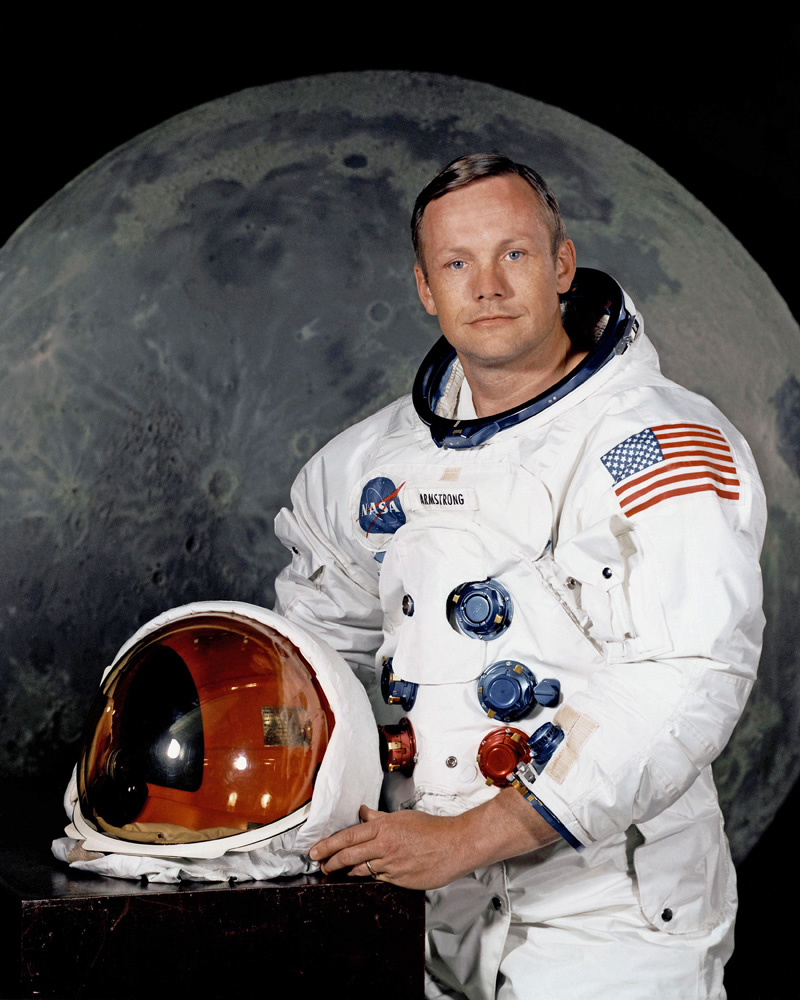
In February 1965, Armstrong was named as the backup commander for the Gemini 5 mission, serving as a replacement for Gordon Cooper. Although he did not fly on that mission, he served as the capsule communicator (CAPCOM). Following the conclusion of that flight, he was appointed commander of the Gemini 8 mission, which launched on March 16, 1966. This made Armstrong one of the few astronauts to be given command on his very first spaceflight. During the mission, he and his pilot, David Scott, successfully docked two spacecraft together in orbit, a first, but Gemini 8 subsequently began to spin violently. The astronauts managed to bring the situation under control, but the mission was cut short. It marked the first time a spaceflight had been terminated prematurely.
After returning to Earth, Armstrong was assigned as the backup commander for the Gemini 11 mission in September 1966. He also served as CAPCOM for the Gemini 9 mission in June 1966.
Because Armstrong remained involved with the Gemini program for a relatively long time, he was not among the six commanders selected for the initial Apollo flights. It was only after the Apollo 1 disaster and the death of Gus Grissom in January 1967 that he moved up in the ranks; in November 1967, he was named backup commander for the third crewed Apollo mission. This gave him a strong chance of serving as commander for the sixth mission. At the time, it was not yet clear how many Apollo test flights would be required, so it was also uncertain whether that particular mission would include a lunar landing. The first moon landing was not scheduled to take place any earlier than the fifth crewed mission.
Thus, the selection of Armstrong as the first human to set foot on the lunar surface was by no means the result of long-term, deliberate planning. As he himself remarked in a 1966 interview, the identity of that individual would ultimately be determined by a stroke of good fortune. The rescheduling of Apollo 8, the success of Apollo 9 and Apollo 10, and the death of Grissom all played a role in how things unfolded.
Apollo 11, with Neil Armstrong, Edwin Aldrin und Michael Collins, launched on July 16, 1969, aboard a Saturn V rocket from Launch Complex 39A at the Kennedy Space Center in Florida, reaching its intended lunar orbit on July 19, 1969. While Collins remained behind in the command module, Columbia, Armstrong and Aldrin descended to the lunar surface the following day in the lunar module, Eagle. A few hours later, Armstrong became the first human to set foot on the Moon, followed shortly thereafter by Aldrin. After a stay of nearly 22 hours, the lunar module lifted off from the Moon’s surface and rejoined the command module (lunar orbit rendezvous). Upon returning to Earth, Columbia splashed down in the Pacific Ocean on July 24, 1969, approximately 25 km from the recovery ship Hornet. Apollo 11 also marked the first time that rock samples from another celestial body were brought back to Earth.
On August 7, 2012, four stenoses were discovered in Armstrong’s coronary arteries, necessitating an immediate bypass operation. Neil Armstrong passed away on August 25, 2012, at the age of 82, due to complications from this surgery.
On September 15, 2012, Armstrong’s ashes were committed to the sea in the Atlantic Ocean from the deck of the cruiser Philippine Sea.