
The Gemini spacecraft had to be piloted and docked with other spacecraft, and spacewalks were also planned. Furthermore, the aspiring astronauts had to familiarize themselves with significantly more launch vehicles, as the follow-up project, the Apollo program, was already in the planning stages. Thus, the individual factories and assembly sites, as well as the launch pads for the Titan, Atlas, Agena, and Saturn rockets, were visited one after the other. Scientific training was also on the agenda, since research work had to be carried out during the spaceflights.
After completing their training, each astronaut had to specialize in a particular area. Ed White was assigned to flight control systems, which suited him perfectly as an enthusiastic test pilot. One of his most important innovations was the standardization of all hand controls across the entire Gemini and Apollo systems.
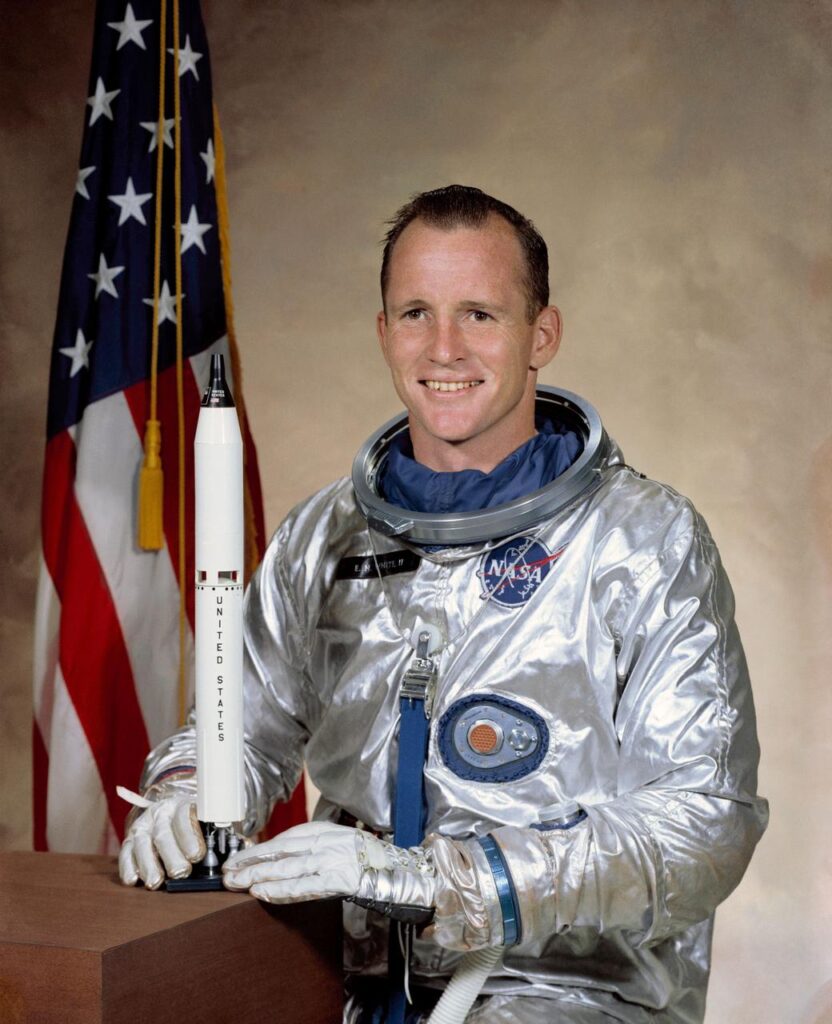
Ed White, along with his longtime friend James McDivitt, was assigned to the Gemini 4 flight. Their mission was to be the first long-duration spaceflight by an American crew, during which eleven scientific experiments were to be conducted. In March 1965, two additional components were added to the flight plan. McDivitt, as pilot, was to maintain the spacecraft at a constant distance from the second Titan rocket stage in Earth orbit, and Ed White was chosen to perform a spacewalk (EVA). White was to receive a new spacesuit and a handheld control unit for his EVA. Both were still under development when the Gemini 4 flight plan was announced. NASA did not publicize White’s EVA until one week before launch.
On June 3, 1965, Gemini 4 launched from Cape Canaveral Air Force Station. Shortly after reaching Earth orbit, it became clear that McDivitt could not keep the spacecraft at the required distance from the Titan rocket stage, as the latter had begun to wobble significantly and was not flying precisely on Gemini 4’s orbital coordinates. Therefore, the crew focused entirely on White’s EVA.
While the spacecraft was on its third orbit over Hawaii, Ed White opened the hatch and ventured out into open space. Using his handheld controller, he was able to navigate relatively easily. He photographed the Earth and the spacecraft with his 35mm camera, while McDivitt, in turn, photographed him from inside the spacecraft. After more than twenty minutes outside, Ed White re-entered the spacecraft. After a total of 62 orbits around the Earth, the Gemini 4 landing capsule landed in the Atlantic Ocean.
Shortly after the end of the Gemini 4 flight, on July 1, 1965, White was nominated as backup commander for the long-duration Gemini 7 flight. The flight took place in December 1965, but White did not fly.
Ed White’s success on the Gemini flight prompted NASA to select him for Apollo 1.
The Apollo spacecraft was far from being as advanced as its Gemini predecessor, so the engineers and astronauts worked under intense pressure to complete the first Apollo spacecraft (S/C 012). The mission, designated Apollo-Saturn 204 (AS 204), was scheduled for the spring of 1967.
One of the most important tests took place on January 27, 1967, at Cape Canaveral. The entire crew, Edward H. White, Roger B. Chaffee and Gus Grissom, took their places in the command module to conduct a plugs-out test. During the test, however, the interior of the capsule caught fire. Due to the use of pure oxygen at a slight overpressure as the capsule’s atmosphere, the fire spread to all flammable materials within seconds. The internal pressure of the capsule was immediately and significantly increased by the computer-controlled oxygen supply. All three astronauts perished because the hatch could not be opened quickly enough, either from the inside (due to the excessive internal pressure from the fire) or from the outside (due to the lack of rescue teams directly at the capsule). The hatch was subsequently completely redesigned, and more than a thousand other modifications were made to the spacecraft and its construction.
Edward H. White II was buried in a state funeral at the cemetery of the United States Military Academy (West Point).